Where Art Meets Jungle: Bohol’s Natural Canvas Unveiled
You know that feeling when nature looks so surreal, it’s like someone painted it? That’s Bohol. I didn’t go expecting art—I went for the tarsiers and chocolate hills—but what I found was deeper. The way light hits the Loboc River at dawn, how the rice fields ripple like brushstrokes—it’s all alive. This isn’t just scenery; it’s nature as living art. And in Bohol, every view feels intentional, like the island itself is an artist. Let me take you through its most breathtaking natural masterpieces.
First Impressions: A Landscape That Feels Painted
From the moment the airplane begins its descent into Tagbilaran City, Bohol unfolds beneath like a carefully composed landscape painting. The coastline curves with gentle precision, fringed by coconut palms that sway in unison, their silhouettes casting long shadows across the turquoise sea. As the land rises, clusters of green hills emerge—rounded, symmetrical, almost too perfect to be natural. It’s impossible not to notice the harmony in the island’s topography, as if an unseen hand had arranged every hill, river, and field into a balanced composition.
Stepping off the plane, the air carries the scent of damp earth and blooming frangipani, a sensory prelude to what lies ahead. The drive inland reveals more of Bohol’s visual rhythm: emerald rice paddies terraced across slopes, their flooded surfaces mirroring the sky in shifting shades of silver and blue. Sunlight filters through layers of foliage, creating dappled patterns on the road that resemble brushwork on canvas. Even the villages seem to grow organically from the land, with houses perched on stilts, their wooden frames blending into the surrounding greenery.
What sets Bohol apart is not just its beauty, but the way that beauty feels curated. Unlike landscapes shaped by dramatic cliffs or violent volcanic forces, Bohol’s terrain appears deliberate—soft, flowing, and harmonious. There’s a sense that the island operates on an aesthetic principle, where form and function coexist in quiet balance. This is not wilderness in chaos, but nature composing itself with intention. The hills roll like waves frozen in time, the rivers meander with lyrical grace, and the forests breathe in slow, steady rhythms. For those attuned to visual art, the experience is familiar: it’s as if the island speaks the language of line, color, and composition.
Travelers often come to Bohol for its famous attractions, but few expect to be moved by the sheer artistry of the everyday scenery. Whether it’s the way morning mist clings to the hilltops like charcoal smudges or how the afternoon sun gilds the edges of banana leaves, the island offers countless small masterpieces. These moments don’t demand attention—they invite contemplation. And in that stillness, one begins to see Bohol not merely as a destination, but as a living gallery, where nature is both artist and artwork.
The Chocolate Hills: Nature’s Sculptural Masterpiece
Rising from the heart of Bohol, the Chocolate Hills stand as one of nature’s most enigmatic sculptures. Comprising over 1,200 cone-shaped limestone mounds spread across four municipalities, they form a surreal panorama that defies ordinary geological expectations. During the dry season, their grass-covered slopes turn a rich brown, giving them their iconic name. From a distance, they resemble an endless field of chocolate kisses arranged with mathematical precision—each hill nearly identical in shape, yet distinct in its placement and shadow.
The main observatory in Carmen offers the most accessible vantage point, where a sweeping view reveals the full scale of this natural phenomenon. On clear days, the hills stretch to the horizon, their smooth contours creating a rhythmic pattern across the land. But it’s not just their number or symmetry that captivates—it’s the way light transforms them throughout the day. At sunrise, they glow amber, their edges softened by the low-angle sun. By midday, they appear crisp and geometric, casting sharp shadows that emphasize their sculptural quality. Come sunset, they warm into deep golds and russets, like a painting touched with fire.
Geologically, the Chocolate Hills were formed through the uplift of coral deposits and subsequent erosion by rain and wind over millions of years. This slow, patient process mirrors the work of a master sculptor—time, water, and wind acting as chisels shaping an enduring form. While scientists explain their origin, the experience of seeing them evokes something beyond logic. They feel intentional, as though nature once paused here to create a monument to symmetry and balance.
For a more intimate encounter, lesser-known trails lead into the hills themselves. Walking among them, visitors gain a sense of scale and texture often lost from afar. The grass underfoot is dry and crunchy in the dry season, while the soil reveals layers of sediment that tell stories of ancient seas. Some paths wind between clusters of hills, creating natural corridors that frame views like living picture windows. These quieter routes allow for reflection, away from crowds, where the mind can wander as freely as the eye.
The Chocolate Hills are more than a tourist attraction—they are a testament to nature’s capacity for artistry. Unlike man-made monuments, they were not constructed with purpose, yet they possess a presence that feels deeply meaningful. To stand among them is to witness a landscape that transcends utility, existing not just as terrain, but as form. In an age where much of the world feels altered by human hands, the hills remain a rare example of natural perfection—an open-air museum where earth and time collaborate to create something timeless.
Loboc River: A Moving Watercolor
Sliding silently along the Loboc River on a bamboo raft is like drifting through a watercolor in motion. The water, clear and glassy, reflects the overhanging canopy above—twisting vines, broad-leafed trees, and drooping ferns that dip into the current like paintbrushes. Sunlight filters through in golden shafts, dancing on the surface in rippling patterns. The air hums with the quiet symphony of nature: the rustle of leaves, the call of kingfishers, the occasional splash of a fish breaking the surface. Every sense is gently engaged, drawing the visitor deeper into the river’s tranquil rhythm.
One of the most distinctive experiences on the Loboc is the floating lunch—a tradition where local chefs prepare traditional Filipino dishes aboard a gently drifting raft. As guests dine on grilled river fish, kinilaw (ceviche-style seafood), and steamed rice wrapped in banana leaves, a small ensemble often begins to play. Music floats across the water—soft guitar melodies, gentle singing—blending with the natural soundscape. It’s not performance for spectacle, but harmony in motion, a cultural expression that enhances rather than disrupts the river’s serenity.
The river’s beauty lies not only in its visual appeal but in its dynamic composition. Unlike static landscapes, the Loboc changes with every bend. One moment, the banks are steep and forested, the next they open into sunlit clearings where children wave from the shore. The reflections shift with the light, the current, and the season, creating an ever-evolving artwork. During the rainy months, the water swells and darkens, taking on a moody, impressionistic tone. In the dry season, it shrinks slightly, revealing smooth stones and sandbars that become temporary islands of stillness.
Sustainable tourism practices have played a crucial role in preserving the river’s delicate balance. Local cooperatives manage the rafting operations, ensuring minimal environmental impact. Motorized boats are restricted, and waste is carefully managed to protect water quality. Visitors are encouraged to observe quietly, to move slowly, and to leave no trace. These efforts reflect a deep respect for the river not just as a resource, but as a living entity—one that gives freely when treated with care.
The Loboc River exemplifies how nature and culture can coexist in artistic harmony. Its flow is not just physical, but emotional—a current that carries guests through layers of beauty, sound, and tradition. To journey here is to participate in a moving masterpiece, one where the viewer becomes part of the painting. In a world increasingly defined by speed and noise, the river offers a rare gift: the chance to slow down, to listen, and to see the world as a fluid, interconnected work of art.
Tarsier Sanctuary: Delicate Portraits in the Wild
Deep within the forests of Corella, a creature straight out of a surrealist sketchbook awaits—the Philippine tarsier. With eyes disproportionately large for its tiny frame, it appears almost too delicate to be real. Each eye weighs more than its brain, giving it a haunting, wide-eyed gaze that seems to absorb every detail of its surroundings. Its body, no larger than a human hand, moves with quiet precision, clinging to branches with slender fingers and leaping between trees with silent grace. To observe a tarsier in the wild is to witness a living portrait—fragile, fleeting, and profoundly expressive.
The Philippine Tarsier Sanctuary was established to protect this endangered species from habitat loss and illegal wildlife trade. Spanning 134 hectares of preserved rainforest, it provides a safe haven where tarsiers can live in conditions as close to natural as possible. Unlike traditional zoos, the sanctuary prioritizes minimal disturbance. Visitors walk along elevated wooden paths, observing the animals from a respectful distance. Flash photography is strictly prohibited, and noise is kept to a whisper—rules designed to honor the tarsier’s sensitivity to light and sound.
What makes the experience so artistically compelling is the contrast between the tarsier’s quiet presence and its intense expressiveness. It doesn’t perform or pose—it simply exists, yet every movement feels deliberate, every glance weighted with meaning. Watching one sit motionless on a branch, its head rotating nearly 180 degrees, is like studying a charcoal drawing brought to life. There’s a stillness in its demeanor that invites introspection, a reminder of the quiet beauty found in restraint.
Conservation here is not just a scientific effort—it’s an ethical and aesthetic one. By protecting the tarsier, Bohol safeguards a unique form of natural artistry. The creature’s survival depends on the preservation of its forest home, which in turn sustains countless other species and maintains ecological balance. The sanctuary serves as both refuge and classroom, teaching visitors about biodiversity through direct, emotional connection rather than lectures or exhibits.
Encountering a tarsier changes the way one sees nature. It’s no longer about spectacle or dominance, but about presence and respect. In its fragility lies a powerful message: that the most exquisite forms of life are often the most vulnerable. The sanctuary doesn’t just save animals—it cultivates empathy, encouraging guests to see wildlife not as objects of curiosity, but as living works of art deserving of reverence.
Bamboo and Weaving: Art Rooted in Nature
Just as Bohol’s landscapes inspire awe, so too does its cultural artistry, deeply rooted in the island’s natural resources. From the sturdy stalks of bamboo to the delicate fronds of nito fern, local craftspeople transform raw materials into functional art. In villages like Antequera and Sikatuna, weaving workshops thrive, preserving techniques passed down through generations. Here, nature doesn’t just provide materials—it informs design, rhythm, and intention.
Bamboo, in particular, plays a central role in Boholano craftsmanship. Grown abundantly in the island’s humid climate, it is harvested sustainably and used in everything from furniture to housing. Artisans split the stalks by hand, shaping them into lattices for walls, intricate patterns for lampshades, or strong frames for bridges. The process is labor-intensive but deeply respectful of the material—each piece is shaped to honor the bamboo’s natural strength and flexibility. The result is architecture that breathes, structures that feel alive, blending seamlessly into the environment.
Weaving, too, reflects a deep connection to the land. Women in rural communities gather nito, a type of climbing fern, and dry it for use in baskets, mats, and decorative panels. The dark, wiry vines are woven into geometric patterns that echo the textures of the forest floor or the ripples of rice fields. Each piece tells a story—not through words, but through form and repetition. The craft is slow, meditative, and communal, often done in shaded courtyards where stories are shared alongside stitches.
Visitors can participate in hands-on workshops, learning the basics of weaving or bamboo crafting from local artisans. These experiences go beyond souvenir-making—they offer insight into a way of life where art and utility are inseparable. A basket is not just a container; it’s a record of skill, patience, and relationship with nature. An eco-cottage built from bamboo is not just shelter; it’s a statement of sustainability and harmony.
This tradition of nature-based artistry reinforces the idea that creativity does not begin in studios, but in forests, rivers, and fields. In Bohol, the line between environment and culture is beautifully blurred. Every woven mat, every carved rail, every thatched roof is a tribute to the island’s living canvas—a reminder that human expression, at its best, mirrors the elegance of the natural world.
Hidden Trails and Rice Terraces: The Island’s Sketchbook
Beyond the postcard views and well-trodden paths, Bohol keeps quieter treasures—hidden trails that wind through hillside farms, village edges, and untouched groves. These routes, known mostly to locals, offer intimate glimpses into the island’s daily rhythms and organic compositions. Here, the landscape feels less curated, more spontaneous, like the rough sketches of an artist’s notebook—unfinished, yet full of potential.
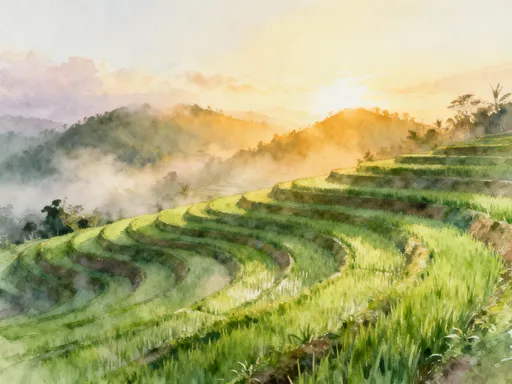
One such trail leads through the rice terraces of Ubay, where farmers cultivate small, irregular plots along rolling slopes. Unlike the grand, stepped terraces of the northern Philippines, these are modest, shaped by necessity rather than spectacle. Yet their beauty lies in their imperfection. The flooded fields reflect the sky in fractured pieces, creating mosaic-like patterns that shift with the clouds. Morning mist often lingers in the hollows, softening edges like smudged charcoal, while egrets wade through the water, their movements precise and deliberate.
Walking these paths, one notices how human activity enhances rather than disrupts the artistry of the land. Farmers work in silence, their figures bent over seedlings, their presence blending into the scenery. Their labor creates accidental compositions—lines of planted rice forming natural brushstrokes, wooden scarecrows standing like rustic sculptures. Even the irrigation channels, hand-dug and meandering, follow the land’s contours with an intuitive sense of flow.
For travelers seeking authenticity, these lesser-known areas offer a chance to experience Bohol at its most unguarded. There are no ticket booths, no souvenir stands—just the quiet dignity of rural life. Respectful exploration is key: staying on marked paths, asking permission before entering private land, and minimizing noise. The goal is not to conquer terrain, but to move through it with awareness, like a guest in a private gallery.
These hidden spaces reveal a different kind of beauty—one not designed for photographs, but for living. They remind us that artistry isn’t always grand or permanent. Sometimes, it’s in the way light hits a puddle after rain, or how a single tree stands alone on a ridge, its silhouette etched against the sky. In Bohol’s sketchbook, every page holds a moment worth noticing, a fleeting composition that exists only because no one tried to capture it.
Why Bohol Changes How You See Nature
Leaving Bohol, one carries more than photographs or souvenirs. There’s a shift in perception, subtle but lasting—a new way of seeing the natural world. The island doesn’t just display beauty; it teaches how to appreciate it. By presenting landscapes as living art, Bohol invites visitors to move beyond passive observation and into deeper engagement. It asks not just “What do you see?” but “How does it make you feel?”
This transformation matters. When nature is viewed as art, it becomes more than a resource or backdrop—it becomes something worthy of preservation. The Chocolate Hills are not just geological formations; they are sculptures. The Loboc River is not just water; it is a moving painting. The tarsier is not just an animal; it is a delicate portrait. Each element gains emotional weight, making conservation not just an ecological duty, but a moral one.
Bohol’s greatest gift is this reframing of perspective. In a world where forests are cleared for profit and rivers polluted for convenience, the island stands as a counter-narrative—one that values harmony, balance, and beauty. It shows that sustainability and artistry can coexist, that economic development does not require the sacrifice of wonder.
For travelers, especially those seeking meaning beyond leisure, Bohol offers a model of mindful tourism. It encourages slow travel, quiet observation, and respectful interaction. It proves that the most profound experiences often come not from ticking off landmarks, but from pausing long enough to truly see. In doing so, it cultivates a sense of stewardship—because we protect what we love, and we love what we understand.
So let Bohol be more than a destination. Let it be an invitation—to look closely, to feel deeply, to recognize the artistry in every leaf, every hill, every ripple on the water. The island reminds us that nature is not silent; it speaks in color, form, and light. And if we listen, if we truly see, we may find ourselves changed—not just as travelers, but as guardians of the Earth’s endless, unfolding masterpiece.